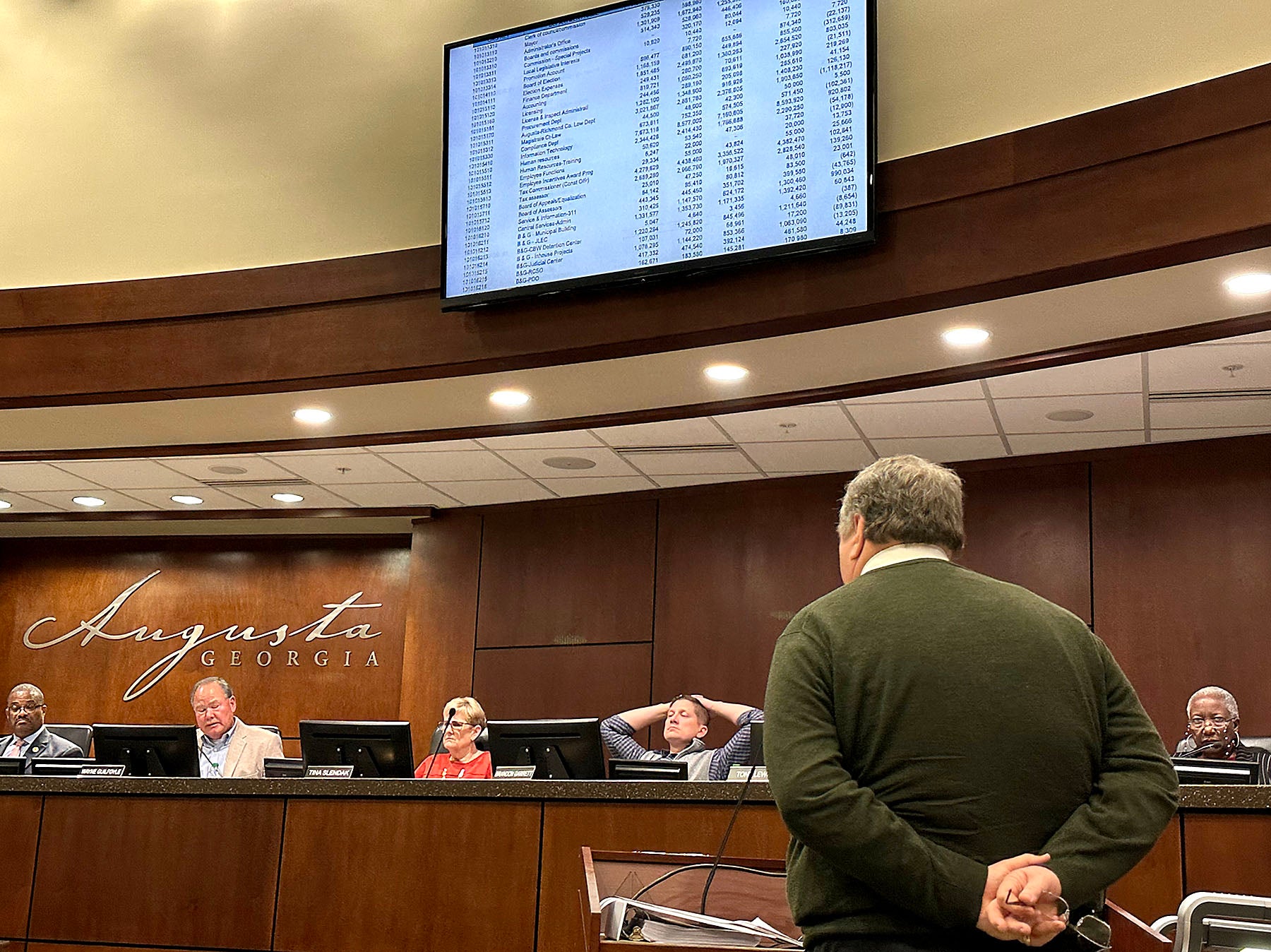
Despite more than seven hours of debate Tuesday, the Augusta Commission could not agree on how to balance next year’s budget, forcing the body to recess an ongoing meeting a third time to stay on track with its Nov. 18 deadline.
Only one vote succeeded: a 6–5 decision to eliminate all discretionary funding for non-governmental organizations.
Administrator Tameka Allen said the cut saves nearly $1 million. It ends funding for groups such as the American Red Cross, Serenity Behavioral Health, Project Access, the Greater Augusta Arts Council and MACH Academy, according to budget documents.
Commissioner Don Clark made the motion, which was seconded by Commissioner Brandon Garrett. Clark has argued the groups receive funding without clear results and that some of the services should be bid out.
“The more we hold onto them, the more we make this an unbearable process,” Clark said Tuesday.
Voting in favor of the cuts were Clark, Garrett, Catherine Smith Rice, Tina Slendak, Mayor Garnett Johnson and Mayor Pro Tem Wayne Guilfoyle.

One-mill tax hike fails 8–3
Garrett next sought approval of Allen’s plan to balance the budget, built around a one-mill tax increase and a series of commission-approved reductions that include the NGO cuts.
These included 3% overall departmental cuts , a six-month hiring freeze that saves $2 million and additional 2% departmental cuts totaling $2.1 million. The plan retains a 1% cost-of-living adjustment to cost $2.2 million, but includes further large reductions at Augusta Transit, Housing and Community Development and the Richmond County Correctional Institution.
Allen said the mill increase would add about $84 a year to the property tax bill for a $100,000 home and $153 for a homesteaded $200,000 home. City taxes make up about one-third of a homeowner’s tax bill, with the rest set by the Richmond County Board of Education.
The motion failed 8–3, with only Clark, Slendak and Garrett in support.
Cutting alone won’t balance the budget
Garrett then proposed trimming specific departments, starting with the mayor’s and commission offices. Allen and Interim Finance Director Timothy Schroer said the cuts would not raise enough to cover the multi-million-dollar shortfall and must be tied to specific line items.
“I will remind the governing body that you cannot cut your way out of this problem,” Allen said, “unless you guys want to cut departments that have a $7 million budget and cut (a) whole department out.”

The lump-sum cuts cannot be applied without naming the reductions, while eliminating positions changes projected savings, Schroer said.
Mayor Garnett Johnson agreed more cuts are needed if taxes are off the table. “If you don’t want to pass on an increase, we’ve got to continue with the cuts,” he said.
Commission inherited budget ‘mess’
Slendak said the current commission “inherited a mess that we didn’t create” and learned the depth of the problem only during this budget cycle. She cited past commission decisions to use temporary COVID-19 relief for permanent expenses.
“There were bad decisions made in a prior administration with prior administrators,” Slendak said.
In 2021, flush with some $82 million in COVID-19 relief, the commission raised the city’s minimum wage to $15 an hour. The increase created an annual cost of $3.5 million, according to prior reports. Allen has said one-time uses of the pandemic funds, which expire this year, helped create the current shortfall.
Alternative millage proposal fails
Guilfoyle then proposed a .85-mill increase paired with the same cuts. It failed 6–5, with commissioners Jordan Johnson, Stacy Pulliam, Lonnie Wimberly, Tony Lewis, Francine Scott and Mayor Johnson voting no.

Without the needed support, Guilfoyle then suggested layoffs and furloughs. Allen said removing 125 positions and adding 12 furlough days would close the gap. He received no second Tuesday.
Tensions rise
Garrett accused some colleagues of refusing to compromise. “If we’re going to make a political spectacle out of this, I think we ought to shine a light,” he said.
Commissioner Jordan Johnson pushed back, saying he would not support raising the sheriff’s budget while also cutting funding for programs “that keep kids out of the sheriff’s office’s hands.”
“We know what we’ve got to do,” Johnson said. “We can get to where we’re trying to go without throwing the baby out with the bathwater.”
Next steps
With no agreement, the commission voted to reconvene the meeting at 9 a.m. on Dec. 16 to continue debate.
Until it properly adjourns the Nov. 18 meeting, the commission can’t convene again to handle new business, such as a proposed plan to purchase $2.4 million in equipment to manage hurricane debris mulch at the city landfill.
The commission has a 2 p.m. called work session Thursday on the SPLOST 9 package.