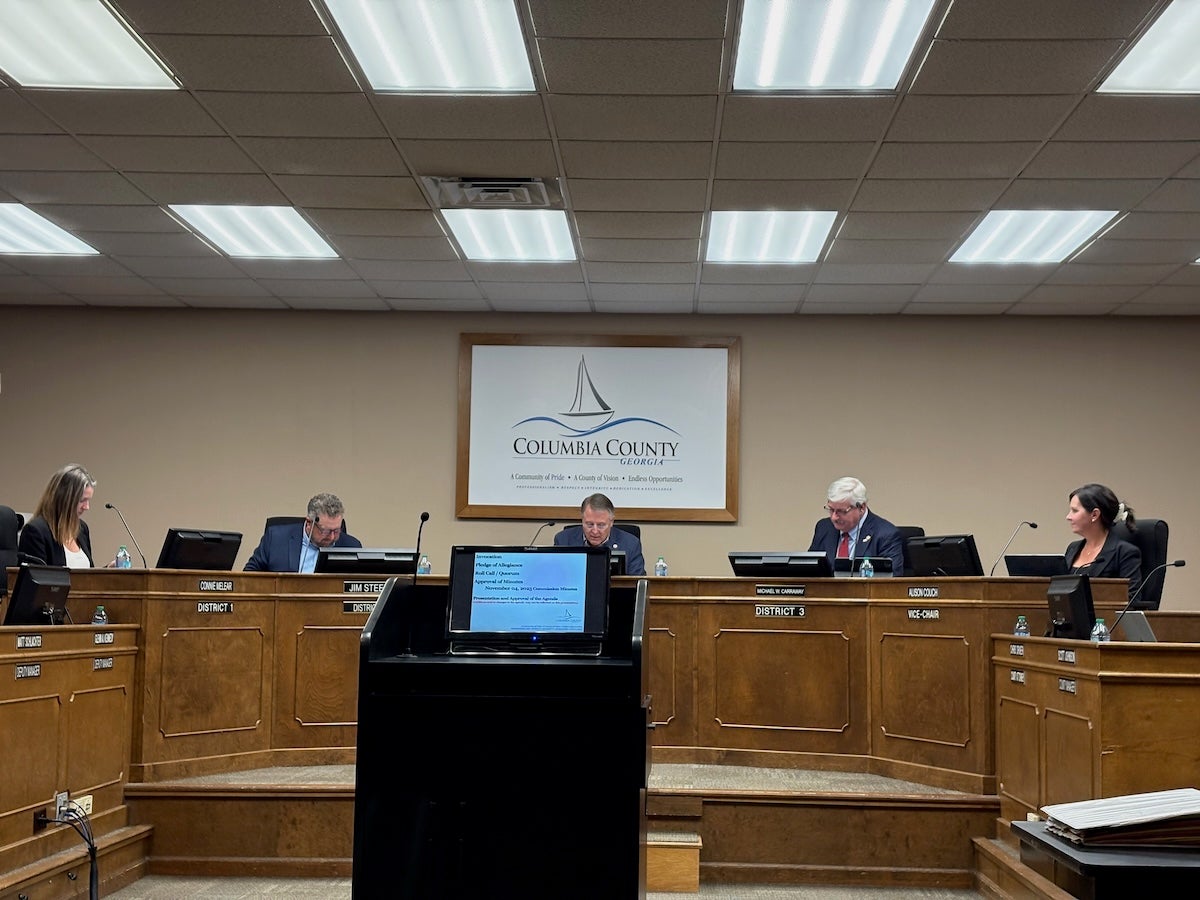
The Columbia County Board of Commissioners approved the first reading for the proposed data center (D-C) ordinance.
Prior to the discussion, the commissioners had County Manager Scott Johnson talk about the proposed ordinance and what’s included. Johnson said it is a new zoning classification that is aimed at data center development.
“We looked at other zoning ordinances from other jurisdictions,” Johnson said. “We’ve travelled to other places, we’ve seen some of the problems other people have had. We tried to take that into consideration. We’ve also implemented what public input we got as far as how it relates to this zoning ordinance.”
Johnson said this zoning ordinance is one of the “more stringent” ordinances the county has seen. He acknowledged that not everyone will be happy with everything in the data center zoning ordinance.
Read more: Augusta Commission makes parking progress but stalls on budget decisions
“Very specifically not only does it create a data center zoning that we would want data centers to fall under, it has very specific allowed uses,” Johnson said. “It has very specific lot structure requirements, such as the height of the building to a maximum height. Buffers is probably one of the biggest things here. Putting the buffers in place with the most intense zoning classifications that really you see in all of our zoning classifications, these buffer requirements are more stringent than those, certainly as it how relates to how it buffers against residential. There’s some additional use provisions as well.”

Johnson said the ordinance also addresses sound with a 70 decibel limit, generator use and testing, lighting, prohibition of wells and people trying to tap into the aquifer. The full ordinance can be found here.
Following the public hearing, which had two community members speak about on the topic, Chairman Doug Duncan issued a statement with an update on the proposed Appling data center.
“I recognize there has been considerable uncertainty surrounding the development of data centers in our county. At this juncture, I am confident that the project is proceeding. In light of this progress, I believe it is essential to provide you with the latest updates available to me.
We have received confirmation that Georgia Power has approved the proposed power consumption model. This approval brings us significantly closer to securing an end user for the project.
Reminder, all costs associated with infrastructure, construction, and utility usage will be fully borne by the end user, with no financial burden placed on our residents.

I anticipate that the developer and end user will complete the land acquisition before December 19th.
Additionally, I have been informed the developer, Trammell Crow, is attempting to acquire other properties in the vicinity. We have advised them that any such properties intended for data center use must comply with our newly established Data Center (DC) zoning classification.
Furthermore, we have notified the developer that it is our desire that the parcel owned by the Development Authority will be rezoned from its current S-1 designation to DC.
It is worth emphasizing that the creation of this new DC zoning classification involved extensive deliberation and effort. We drew upon best practices from other jurisdictions while prioritizing the needs and concerns of our residents.
Make no mistake: these regulations are rigorous and far from conciliatory. In fact, they impose some of the most stringent requirements in the nation on developers and end users alike.
Read more: Bond resolution and book concerns dominate Columbia County Board of Education meeting

I have frequently been asked why Columbia County is pursuing data centers with such interest. The reality is that these facilities are an emerging industry trend, and they generate extraordinary levels of revenue-funds capable of transforming communities for generations to come.
Regarding the allocation of this additional revenue, top priority our will be on delivering substantial tax relief to our residents. While some may express skepticism about whether this will materialize, I am pleased to report that we are actively collaborating with our state legislators to enact Homestead tax relief provisions into state law. This measure will ensure that our commitments are upheld by future commissions.
Please note that these benefits will not materialize overnight. This is a multi-year endeavor, with revenue increases expected to escalate gradually. That said, it is my sincere hope that we will begin to realize the tangible outcomes of our efforts within the next two to three years.”
Read more: Mayor Garnett Johnson keeps tradition rooted with annual sweet potato giveaway
Public comments
During the public comment portion of the meeting, several community members spoke up about the proposed data center in Appling. One of them was Janice Muller, who asked several questions and went back and forth with Johnson when he answered the questions.
Muller asked if the county really wants input from the citizens on the data center because they vote on the issues as soon as the citizens are done speaking.

“Why the effort to engage the citizens if you had no intention of incorporating any of the suggestions that were offered. once again you mislead the citizens into believing they had a voice and that you value their input,” Muller said. “But nothing ever changes. Instead, the zoning board rubber stamped the new ordinance and passed it on up to you. It’s obvious by actions thus far you’ve already made your decision as it relates to the ordinance.”
Muller said the state of Georgia can override the county ordinance when it comes to the no wells being allowed under the D-C zoning and allow wells to be drilled because permits are issued by the Georgia Department of Natural Resources Environmental Protection Division (EPD).
Johnson said this is not correct.
“The county cannot enact any rule that is less stringent than the state,” Johnson said. “It can enact rules that are more stringent than the state. What we’re talking about here is a zoning classification and conditions to zoning. If we put something in our zoning ordinance that says no wells, it doesn’t matter that the state permits them. If they drill a well and it was in our ordinance that they couldn’t have them, they would be in violation of their zoning. We would then enforce that zoning on them. So, the fact that they may be able to get an application to that does not mean they’re allowed to do that.”
Muller also stated the Economic Development Authority of Columbia County (EDACC), in a September meeting of the executive committee, had a discussion on aquifers, well drilling, water rights and water tapping capabilities.
“Are you researching tapping into the aquifers because you have come to realize there isn’t enough water capacity for further development, whether it’s commercial, industrial or residential beyond what’s already promised by Trammel Crow…Are you just now realizing that the water allotment from the Army Corps of Engineers isn’t going to be enough in years to come,” Muller said. “I know you were warned about that possibility by the Savannah Riverkeeper in a previous BOC meeting. She stated there isn’t enough water and that several surrounding communities that pull from the river don’t have enough water for their fire suppression and yet you want to take more?”

Johnson stated while he can’t speak for the EDACC, he can speak for the county, which is continuously growing. Due to that, they are permitted to draw more water from the county than 20 years ago and that will increase in another 20 years.
“We are permitted to produce about 54 million gallons a day,” Johnson said. “On the hottest day we use about 38 million gallons. We have 16 million in capacity today without drawing any more. But nobody is really talking about that. Columbia County has sufficient water.”
Muller also addressed the data center in Social Circle and the claim that residents’ wells are running dry because of the data center.
“I have spoken to the county manager of Newton County, had a conversation with them. I’ve also spoken to the folks that were on the Meta team, and they do not have wells at Social Circle…they do not have them,” Johnson said. The residents are upset because the data center came and they’re having the same narrative. I’ve had the conversations.”
Johnson also addressed the comment by the Savannah Riverkeeper and said he spoke to the county manager and city manager and confirmed the issues were from a failing county and city system.
Aaron Bilyeu with Clover Leave Infrastructure spoke and said his company also develops data centers and would like to develop in Columbia County. He said he thought the ordinance was a good one.
“I think the standards that are being proposed, the zoning does a good job addressing a lot of those (concerns),” Bilyeu said. “I will say this really does represent the best practices in the industry. We work with a lot of different communities that are implementing these standards and what you’re putting in place really represents the best of the best sort of in an aggregate.”
He said some of the items would be difficult for a data center to meet, such as the setbacks. But he looks forward to working with the county on potential projects in the future.
“Data centers do represent a significant economic development opportunity, and I know there are concerns about them. But in terms of being a good neighbor and having minimum impacts, they really are much better than a lot of the alternatives,” Bilyeu said.
Bilyeu said he was involved in the development of Meta data centers and confirmed there are no wells at that Social Circle data center.
“We also conducted a study there that confirmed that the ground water flow was actually from that particular neighbor’s property toward the data center,” Bilyeu said. “So, there was no possible way that the Meta facility had any impact on the neighbor in question that’s been in the media relative to Social Circle.”
The second public hearing on the data center ordinance will be held on Tuesday, Dec. 2 at 6 p.m. during the Columbia County Board of Commissioners meeting.