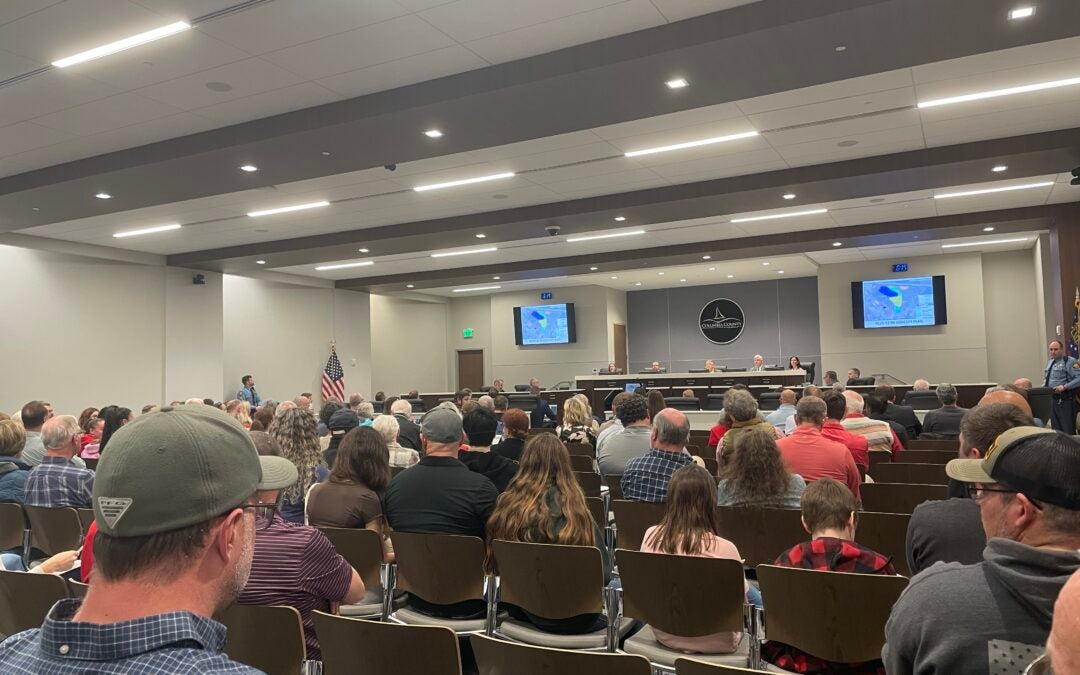
The government auditorium wasn’t as crowded at the Dec. 2 Columbia County Board of Commissioners meeting as it was during earlier debates over the White Oak Technology Park in Appling.
Still, five residents came forward to oppose the new zoning ordinance for data centers, many repeating concerns previously raised about the White Oak project. One speaker asked plainly whether any commissioner would want a data center built next to their home. Another, a retired Columbia County teacher, spoke about her family’s deep connection to their Appling property: the abundant tree frogs, the years her children and husband spent hunting and fishing there. The beauty and rural character of the area are not abstract concepts to her; they’re part of her daily life.
Based on much of the online chatter and comments I’ve heard, many residents in Appling and Harlem feel let down by how their areas were represented throughout earlier stages of the project. Some expected more robust advocacy, early communication, and clearer engagement. Instead, they felt the project moved too secretly in the early phases, and too quickly once it became public. That perception, fair or not, reinforced a belief that decisions were already made before the public ever had a chance to comment.
As expected, the commission unanimously approved the new ordinance creating a dedicated zoning category for data centers, minus new Commissioner Jim Steed, who was not present. This new zoning will not automatically apply to the existing White Oak Technology Park property. However, The Augusta Press reported in mid-November that the developer (Trammel Crow) intends to rezone the property to the new designation.
I stand by what I wrote a few months ago: growth is inevitable. My husband grew up in Athens, and while driving past a stretch of new development over Thanksgiving, he pointed out the window and sighed, “I remember when all of this was just trees and farmland.” I told him he had officially become the “old man shaking his fist at progress.” The moment was funny, but it also made me think about how differently people experience growth depending on where they live and what they stand to lose or gain.
The Non-Disclosure Agreements (NDAs) signed by commissioners during early negotiations remain a major driver of public mistrust. As I wrote before, Chairman Doug Duncan explained that NDAs are common in economic development. I don’t dispute that, and I understand the importance of protecting proprietary business information.

However, it’s often the given reason (or excuse) for why the project was not brought to the public earlier. When I submitted an Open Records Request for the NDAs, the Economic Development Authority of Columbia County (EDACC) declined to release them. In an email, EDACC Executive Director Cheney Eldridge wrote:
“The developer has requested that the NDA not be disclosed. The Development Authority is going to oblige that request as the documents are protected under the Georgia Open Records Act until, at a minimum, there is binding commitment with an end user. See O.C.G.A. § 50-18-72(a)(46); O.C.G.A. § 50-18-72(a)(34); Spencer v. Cherokee Cnty. Sch. Dist., 375 Ga. App. 789, 795.”
That interpretation may be legal, but from a public-trust standpoint, it raises an obvious question: why can’t the public see, even in redacted form, the document that restricted what their elected representatives were allowed to say and when? These NDAs prevented commissioners from discussing one of the most significant economic development projects in county history until two weeks before the Planning Commission hearing. If the NDAs are truly routine and harmless, then a redacted version should be released. Asking residents to trust a document they cannot see is a breeding ground for speculation, especially at a time when people are understandably wary of large corporations. Withholding the NDAs amplifies those concerns and pushes those suspicions onto local officials as well.
At Tuesday night’s meeting, frequent critic Lee Muns spoke during public comment, and I followed up with him afterward. Muns speaks very confidently about many aspects of data center development. Whether all his claims hold up under scrutiny is a separate matter, but his arguments resonate with many residents.
“If I were in their seat,” Muns said, “the first thing I would have done is read the NDA line by line. When you’re elected to represent citizens, you have to know exactly what constraints you’re agreeing to.” He also criticized the lack of early engagement: “There should have been a town hall before the rezoning… people should have been aware before this moved forward.” On the overall process, he added: “Too many decisions were made out of public view. Even if every step was technically legal, it still erodes trust when people feel like major discussions happen somewhere other than the public meeting room.”
Regarding the newly created Data Center District, Muns expressed concerns about whether the county will realistically be able to enforce the rules. As an aside, some of his more speculative claims, particularly about potential future energy infrastructure in the local area, cannot be independently verified in the time available for this column. The process-based concerns he raised echo what many other residents also feel, though.

I also reached out to the county, and County Manager Scott Johnson responded to the questions I submitted about residents’ concerns. On the 70-db noise limit that some residents argue is too high, he said the county studied several active data centers in Georgia and Virginia and “never encountered a data center over 70 db.” He added that ambient readings at the White Oak site already range from 65.5 to 75.4 decibels, and that setting the limit lower “could have made all projects unviable.” Regarding wells and water use, Johnson stated that the county is “not aware of any long-term water impacts due to data centers.” He reiterated that protecting natural resources remains a priority. Regarding buffers, he stated that widths “should not change over time,” noting that any amendment would require public notice and two readings. Johnson also said the ordinance includes “one of the most restrictive buffer requirements to neighboring residential among those we reviewed,” and that berms were added to further shield nearby homes.
As for communication, Johnson said the county “has been fully committed to an open process,” citing public hearings, the May rezoning meetings, Planning Commission sessions, and documents posted online. He said the county incorporated public feedback into the new ordinance and plans “robust additional outreach” as the project progresses. He also framed the political issues around White Oaks in terms of representative democracy, arguing that residents elect officials to study complex proposals and make decisions without requiring a public vote at every step and for each proposal, while still preserving opportunities for comment. In his view, the phased approach and new zoning framework reflect that balance.
Beyond the political debate, the ordinance itself represents a shift in how Columbia County regulates this industry. The new “D-C Data Center” zoning district is far more prescriptive than other industrial categories. In addition to the 70 db noise cap and expanded setbacks, it requires substantial buffering from nearby homes (500 feet next to residential), includes berms as visual and sound barriers, prohibits on-site wells, limits generator testing to 8 a.m. to 6 p.m. (while still maintaining the 70db cap at the property line), and sets lighting controls intended to reduce nighttime impacts on surrounding properties.
While the ordinance does not retroactively apply to the existing White Oak zoning, county officials say it was crafted in response to concerns raised after the May votes. Whether the measures go far enough for residents remains to be seen. Still, the new district reflects the county’s attempt to address issues that were not contemplated before White Oak surfaced. Some residents, Muns included, believe this sort of analysis and research should have been conducted before the White Oak project was approved.
I also want to note that the county met its legal obligations by notifying the public about White Oak Park. The Augusta Chronicle published the required legal notice on April 16, along with a county sign posted on the property. The Augusta Press reported on April 21, 2025, that EDACC was seeking to rezone a large area for a technology park at White Oak. The proposal information was technically public in mid-April. Still, relatively few people knew about it until the Board of Commissioners voted. This isn’t necessarily the county’s fault. People are busy, and few of us regularly comb through legal notices online. It suggests that notification laws may be outdated for how people consume information today. Critics of the project argue that the county should have gone beyond the minimum legal requirements.
Many residents didn’t even know what a data center was before now, and they don’t feel the minimum 15-day notification period provides enough time for public engagement. Columbia County can learn from this moving forward. If the county wants to build confidence before the next major project arrives, several improvements will help:

- Revisit NDA terms and set earlier expiration dates so elected officials can communicate more openly and earlier in the process.
- Engage the public earlier rather than relying solely on legal minimums.
- Extend public notice periods beyond the 15-day statutory minimum.
- Use modern platforms (like social media) to notify residents about major zoning cases.
At the end of the day, the White Oak project is moving forward. It may be a “done deal,” but I still call on local environmental groups to work with the developer to make the project as ecologically responsible as possible. In Appling and Harlem, many residents say trust in their local government is gone. Rebuilding that trust will require more than a new zoning category or assurances from the current commission. It will take consistent early communication and genuine engagement before significant decisions are made. Growth will continue to be part of Columbia County’s future, but how that growth is handled, and whether residents feel included in the process, is a fundamental issue here.
The next Columbia County Board of Commissioners meeting is on Dec. 16 at 6 p.m. in the auditorium located at 630 Ronald Reagan Drive in Evans. I hope to see you there.
Karin Parham is a former military officer and currently serves as the CEO of the Freedom to Read Coalition of Columbia County and as treasurer of the Columbia County Democratic Committee. She writes a Substack about current issues in Columbia County. The views expressed in this column are solely my own and do not represent the official position of the Columbia County Democratic Committee or any other organization with which I am affiliated.