by Ty Tagami | Dec 10, 2025 | Capitol Beat News Service
ATLANTA — Georgia’s utility regulator has reached a tentative agreement with the state’s electric power monopoly that would allow a major expansion of energy production, mostly from natural gas.
The Public Service Commission’s public interest advocacy staff had previously advised approving only a third of Georgia Power’s request for a 10-megawatt expansion. They had argued in November that ratepayers would face “unreasonable risk” if the company built its new power plants and no one came to use the energy.
But on Wednesday the agency revealed that the staff had negotiated a “stipulated agreement” that would authorize nearly everything Georgia Power requested, with some new guarantees for ratepayers.
The company wants more capacity so it can sell more energy as it forecasts massive growth in demand from data centers. Those server warehouses that power the internet have been sprouting across the state and devouring evermore energy to enable the computations behind artificial intelligence.
The agreement will not be final unless the five elected commissioners approve it at another hearing scheduled for Dec. 19.

At month’s end, two of them will be off the commission, having lost decisively in the November election to two Democrats who campaigned against a spate of utility rate price hikes.
One of the incoming commissioners, Peter Hubbard, attended a protest outside the commission offices before Wednesday’s hearing, where he said he had just learned about the new agreement revealed earlier in the morning.
He said the estimated cost of $17 billion was just the start and that it could rise to $50 billion or even $60 billion during the 45-year lifespan of the new power plants.
He warned that “speculative customers” for those plants might not show up if they find better deals in other states, and he said a “data center bubble” could pop, leaving ratepayers on the hook.
The state can provide affordable, clean and reliable energy, said Hubbard, who takes office Jan. 1, “but we must not lock ourselves into a massively expensive mistake, with the decision made by two commissioners who are just days away from leaving office.”
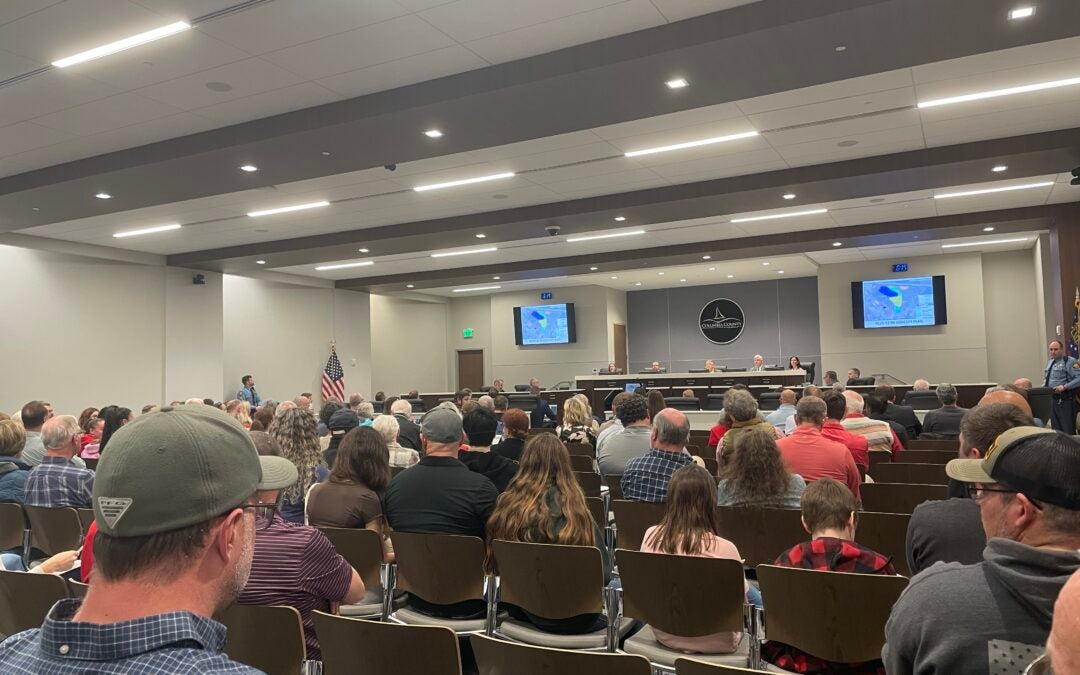
The protest moved indoors for the hearing, where police escorted several out the door after they disrupted the start of the hearing.

“This whole meeting is a sham, they’ve already made a deal,” one man yelled on his way out.
Nearly 50 members of the public then got to speak. A handful, including a developer and a representative of the Clayton County Chamber of Commerce, backed the expansion, saying economic growth and jobs depended on reliable power.
But a representative from DeKalb County read a resolution by the county commission that called on the Public Service Commission to delay its vote to ensure more time to evaluate the impact on local governments, customers, public health and the environment.
Some were concerned about cost, such as Joshua Tolbert, a power generation engineer, who said Georgia Power should only be authorized to build plants for customers with executed contracts.
Others, such as Satya Vatti, a nurse, felt violated by the new tentative agreement, saying it would allow Georgia Power to profit while ratepayers assumed the risk.
“While working people agonize over the necessities they’ll be able to afford and which they’ll have to cut each month, Georgia Power investors and executives are raking in cash,” said Vatti, who described herself as a socialist.

Ava Trachtenberg, an environmental science student at Emory University, spoke about the effect on climate change of burning more fossil fuels for energy. She said she was concerned that extreme heat, flooding and drought would cause crop failures and political instability.
“I don’t know about you, but I want my future to be livable,” she said.
Records from a November hearing indicate that the commission’s public advocacy staff had misgivings about forecast demand.
“Staff’s primary recommendation is that the Commission should approve the acquisition of 3,125″ megawatts, the document said.
The staff’s turnaround Wednesday was due in part to a pledge by Georgia Power to calculate rates based on the forecast revenue from “large load” customers like data centers. The pledge means a “downward pressure” for the typical residential customer’s rates, amounting to $8.50 a month, said Jeffrey R. Grubb, a director at Georgia Power who testified Wednesday.
“We want to assure the commission and our customers that certification of the requested resources will not change residential customers’ rates,” said Grubb, who directs resource policy and planning for the company. “As we have stated before and reiterate here, existing customers will not pay for the cost associated with serving new large load customers because those new large load customers are covering the incremental cost to serve them.”

But that guaranty is only good from 2029 through 2031.
Tricia Pridemore, one of the five commissioners, said large load ratepayers drive economic development and pump tax revenue into local government. She said she’d heard of one community that was “retiring” property taxes because of the income and others using the proceeds to build schools or waterworks.
That is a “tremendous benefit,” she said. “So when these folks up here want to talk about affordability, that’s just one more way where that revenue is being put to use at a local level.”